Header with Links to Social Media Sites

Image Map

Reading Comprehension Passages Level J-N Video

Hello friends! I hope you are all surviving the long winter! I don't know about you, but it seems like our family has been trampled one week after another with some virus or another! Yuck! We will certainly be ready for spring to come sooner rather than later! 

Today I am going to share with you my newest video on TpT explaining the WHAT, WHY and HOW behind my best selling Reading Comprehension Passages Bundle Levels J-N! Click on the image below to see the video....

******************************************************

                                        >>> Video <<<
******************************************************

It's pretty crazy to me that we are doing videos now... Andrew and I that is... It's TOTALLY out of my comfort zone. I would much prefer to be in front of a group of 7 year old children than publishing videos for the world! But I do have to admit, it's been a great thing for Andrew and I to do together. He's so talented when it comes to all things technnology, and I have a STEEP LEARNING CURVE, so we're a great pair. 

Anyways... here's the gist of it: 

These passages are short and high interest for students, designed to allow students the opporunities to use their decoding and comprehension strategies. The passages are leveled using the Fountas and Pinnell leveling system. In the past I have taught in districts using DRA and F&P. I am personally a fan of Fountas and Pinnell... I LITERALLY love their work and subscribe to their weekly newsletter because I'm a nerd like that --haha! But if your school uses another leveling system, take a look at this chart to help you figure out which passages would meet your students needs. 


I am also attaching a K-5 chart for you to use for future reference, if you'd like to download it and save for a later date! 


Did you know that research shows that using SHORT, HIGHLY FOCUSED passages are most effective for teaching guided reading? These passages have been designed for students to find TEXT BASED EVIDENCE, a major shift in the common core. 


Before moving down to my 1st-2nd grade loop, I taught 5th grade for two years. Now, I am not a fan of all things common core, by any way, shape, or form.... However, I can tell you I would have liked it if my kiddos came into 5th knowing how to prove their thinking!!! I can also tell you that after I embedded into our daily routine in guided reading... my first graders could do it, no problem by the end of the year! And it taught them how to pay attention to detail, too!


Teaching kiddos how to activate higher level thinking at an early stage is a must as well... It sets them up to think deeply and critically. Strategies such as predicting, inferring, synthesizing, drawing conclusions, analyzing, questioning, making connections, and so on, are all crucial to this development. It may seem overwhelming at first, but it becomes more natural overtime... and I have included questions that activate higher level thinking in this bundle to make your lives easier!


Now, I am an advocate of flexible grouping... mixing kids up, keeping it fresh. However, not when it comes to guided reading. It is SO IMPORTANT to assess your students to find their instructional reading levels and then teach them at that exact level. If you are giving your students passages and questions for reinforcement during centers or for homework, you'll want to use their independent reading level so they do not become frustrated. 

If you are not sure how to find your students instructional or independent reading levels, check out this freebie... It has a running record template and the algorithms to find their appropriate levels  >>>  Running Record Template and Reading Level Algorithms Freebie

So there you have it, I hope this is helpful for you with your reading instruction in your classrooms! 

If you are interested in purchasing the Reading Comprehension Passages J-N Bundle, you can find it here >>> Reading Comprehension Passages Bundle J-N

Or if you'd like to check out the Sampler Freebie, you can find it here >>> Reading Comprehension Passages Bundle J-N Sampler Freebie


4 Benefits to Sensory Bins + Easy Tips for Creating Your Own


Do you use sensory bins in your classroom or at home? It has been shown that people, children and adults alike, learn best when using all of their senses. True, some people are auditory processors while others are visual learners, others still would consider themselves kinesthetic learners, regardless of preference, we all function best when we've had multi-sensory exposure.

Studies have been conducted which led the the following FOUR conclusions about sensory play and learning for primary aged children. 

ONE: Using sensory play, or in this case sensory bins, aids in cognitive development. Life is full of "problem solving situations," and it is our role as educators and parents to equip them to think deeply in order to find solutions. Sensory play allows children opportunities to predict, hypothesize, observe, react, and much more... all of which aid in cognitive development!

TWO: Sensory play helps to develop physical skills as well. Fine motors skills, which is the dexterity of small muscles and hand-eye coordination, begin to develop at an early age. Working along side fine motor skills are gross motor skills, which include larger movements a child learns beginning with crawling and walking, moving on to running, skipping, and jumping etc. In many cases, fine motor and gross motor skills require a little tune up, as little minds often race faster than their bodies can respond! Sifting, mixing, churning, scooping, and pouring can all assist in developing these physical skills, essential for success. 

THREE: Language development begins in children long before they are able to express their thoughts verbally. It is a continual process of acquiring new language and figuring out how to appropriately express those thoughts. Collaborative sensory play offers a venue for children to communicate their thoughts to one another in a constructive manner. The different senses that are stimulated while using a sensory bin can also develop descriptive language.

FOUR: Last and certainly not least, sensory play helps to develop social and emotional intelligence. As sensory play is developmentally appropriate, children are able to feel in control of their play and develop positive self efficacy. Learning to cooperate and share are essential to positive relationships, both of which can be cultivated during sensory play... Not to mention the avenue for creativity that is explored while using sensory bins. 

Are you convinced yet? If not, let me show you how quick and cheap they are to assemble for your classroom or home! Here is a one minute video demonstration so you can see the process in action, plus more details & a free editable template below!


I made them at home with my two year old... she LOVED being the helper, as I am sure you can image!!! 


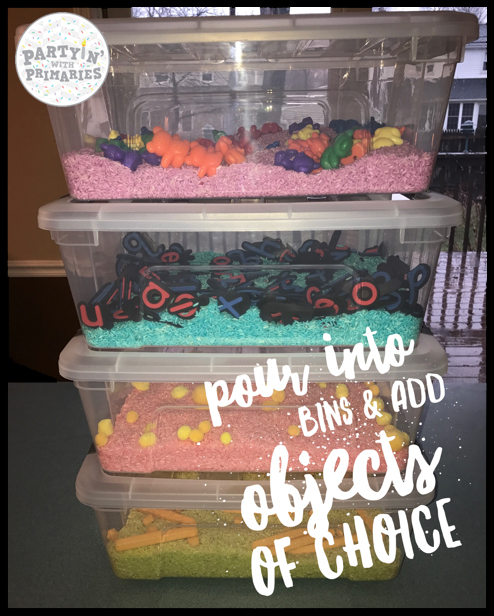
First, I purchased clear plastic bins from Coscto.... 6 bins for $10.00 AND I got 25 pounds of rice for 8 bucks! You can't beat it... Can you tell I have a secret, ahem... not so secret, obsession with Costco?!? Confession: I LOVE bulk shopping... We have a membership to both BJ's AND Costco! Ha!


The rest is simple. All you need is the following:


* 10 cups of rice
* 3/4 cup vinegar
* 30 drops of food coloring of choice
* 1 gallon sized zip-lock bag
* 2 trays covered in parchment paper 
* 1 plastic bin (+ items of choice for bin)


Scoop the rice into the ziplock bag and then combine the vinegar and food coloring. Next, pour the mixture into the ziplock bag. 


Shake and/or stir the bag until the colored vinegar has covered all of the rice. 


Dump the rice onto the two trays covered in parchment paper and spread thin to dry. **It usually takes about 10-20 minutes to dry**

When you are finished, simply add objects of your choice into the bins of colored rice and VOILA... you have build your own sensory bins!


You may be thinking... sensory bins seem great, but where will I fit ONE MORE ACTIVITY into my school day?? I understand very well how precious time is at school. Sensory bins can be set up as stations for morning work. They can also be built into math or ELA centers throughout the school day. Not to mention, sensory bins can be a great educational indoor recess activity, especially for those poor weather days when the kids are cooped up inside and need to release some energy! 

To make things even more simple for you, I have created a few templates for you to give your kiddos to complete during their sensory play! Click here to download your free EDITABLE templates. 


If you are looking for more information on sensory play, check out this article by PBS.  Happy Teaching!


Citizenship

Now that the school year is well underway, some of our little friends may be needing reminders on how to be a kind friend or good citizen. I am a firm believer in the importance of character education. Social skills are just as important as learning academic concepts at this stage in the game! We need to teach our children to be well rounded individuals... and that begins with how they treat those around them! Unfortunately, there are just not enough hours in the school day, so I try to embed these lessons into our literacy block.


One of my favorite book series for primary aged children is Frog and Toad. The characters are kind but silly, and always seem to be learning some type of lesson that the kids can pick up on.


Frog and Toad are Friends by Arnold Lobel leads to excellent discussions about equality, fairness and respect. These three concepts are a large part of friendship and citizenship, and this book models it in a way that is comprehensible for seven year old kids! After reading the book aloud, I like to engage the students in a whole group discussion about the ways Frog and Toad were kind friends to each other in the book. I lead with the example of Frog writing a letter to Toad when he felt lonely. We talk about how it would feel to receive a letter if we were feeling lonely -- most kiddos agree that it would make them feel better. 

Then the children pair off and talk about ways they can be good friends to each other. After two minutes, we come back as a large group and share our answers. In the past my students have come up with answers like: "Ask a friend to play at recess that looks lonely." "Share your toys at recess." "Tell a friend you like their shirt." It is amazing how quickly they're able to make connections to their own lives.


The next day, we do a cute "craftivity." We review how Frog and Toad were kind friends and how that connects to their own lives. We examine the ideas they came up with the previous day and then they create their own Frogs and Toads with speech bubbles explaining how each individual is a good friend. They always look adorable in the end... they're great to decorate the classroom or hallway... AND serve as a reminder of how to be kind friends/good citizens.


Once they have grasped the concept of being good friends, they can then move on to the more broad concept of being a good citizen. Another day, we spend time thinking about what it means to help in our own community, and ways in which we can do so. I don't know about you, but my kids always love watching books on the smartboard. 


It really isn't anything different than a read-aloud but it just spices things up a bit. So we "watch" the book City Green by DyAnne DiSalvo-Ryan. (You can click on the image below for the link to the read-aloud.)


When we finish watching City Green, a book about a girl that works to make her city beautiful, we brainstorm ways that we can help our community. 


After the minds of the students have been primed, they head back to their seats to start making their own lists of ways to help in their community. Some of their ideas were quite inspiring! I just love how their little brains work!


We also started a class collection of canned goods for a local food pantry. We kept a bag in the front of our classroom for the kids to bring in items from home to donate. Our goal was to fill a brown grocery bag... and we did! It was heart warming to see how excited the children got as we worked to fill a bag of food for those in need.


If you found these ideas helpful, check out the Interdisciplinary Citizenship Unit written by Lauren's Learning Corner and myself. 


This 20 day unit is aligned to the Common Core Standards and includes activities, read alouds and projects similar to those you read about above. 


I hope you found a few ideas that will be useful in your classroom! Thanks for stopping by and keep up the good work!


Determining Importance

In a previous post, I raved about Tanny MacGregor's book Comprehension Connections. It is just full of great ideas. Even though our Smashing Strategies for Guided Reading series is finished in the spring, I am still going to continue with a few more helpful tips that may aide in making your guided reading a little easier!


One strategy that I find very difficult for my primaries to grasp is Determining Importance. I am sure you have been there... you ask for a quick summary and then get a five minute, play-by-play retelling of an ENTIRE BOOK! So cute, but not exactly what you asked for!


Because primary aged students are concrete thinkers, I love how Tanny demonstrates what determining importance looks like in a practical and tangible way. The first thing that I did, was pull our my personal handbag (aka purse), which is shamefully messy. Having a two year old, I always just end up throwing things that I need and wait, what seems like months, before cleaning it out again. So, to kick off our lesson, I became a bit vulnerable and showed my students the reality of my deep, dark purse! I pulled out many of the objects in the purse and asked them to help me figure out which items I needed to come to school that day. They had to DETERMINE what was IMPORTANT for me to bring to school.


Of course, they thought it was hilarious when I pulled out a bottle of nail polish, coupons for a box of Popsicles (yum!) and essentially, other useless junk. They were quickly able to deduct that I only really needed my keys, to drive to school. My wallet, which contained my driver's license and the colored pens that I use for correcting. Aside from that, there wasn't much else that I needed. It was all just extra fluff. (Don't mind my bare feet... preggo problems...)


The next demonstration was hands-on and the kids flipped when they got to participate! We talked about how sometimes when we read, there is extra stuff, that is just not important. Kind of like when parents cook pasta on the stove. I asked them to walk me through the steps...

First, their parents have to put water into a pot and let it boil on the stove.


Then, they had the pasta to the boiling water to let it cook.


STOP. I asked them, when the pasta was finished cooking in the water, if they just ate it right out of the pot? Like soup, pasta in hot water. NOOOO! They all shouted! After that, water had to be strained right out of the pasta.


WOW! I stopped them here. "So you mean, that the water strains out of the pot, and all the important stuff (aka pasta) stays in the pot. Just like when we read... we want to get rid of all the extra information and only remember the MOST IMPORTANT information. Determining Importance."

Ahhh... light bulbs went off in their little brains, like the 4th of July! So fun!

At this point, I introduced our FOUR THINKING STEMS that they would be using to complete their sticky note assignment during guided reading that day.

* What's important here...
* One thing that we should notice...
* I want to remember...
* It's interesting that...

The kids then went on to do their quiet reading at the guided reading table. I listened to each one, checking for fluency and comprehension. All the while, they were using the thinking stems to complete sticky notes for information in the book that they determined important. I tell you, if you haven't used sticky notes for your guided reading yet, I would highly recommend it. They absolutely love it and it's a great quick check for you, the teacher, to assess their understanding of the strategy at hand.


At the end of the guided reading session, which flies by in what seems like two minutes, I asked them to each choose the sticky note that they were most proud of for the day. They would then share it with the group. With some groups, if time ran short, I had them share their sticky note with the friend sitting next to them, and I listened in to each conversation.


The following week, I gave the students half sheets of paper with these Determining Importance thinking stems listed to use during their Daily 5 stations, This way I could see the progress, if they were able to Determine Importance at their independent reading level without my support at the guided reading table! Happy Teaching!


The Best School Year Ever GIVEAWAY

As many of you may already know, the Teachers Pay Teachers website is running a HUGE SITE WIDE PROMOTION  August 1st & 2nd! Everything in my store will be 28% off and the sale will continue in my store for the rest of the week, too!


And to piggy back off the sale... I am going to have a $50 TpT Gift Card Giveaway AND be running new promotions every day Monday - Friday including:

- $1 Daily Deals
- Daily Freebies 
- Daily 50% Off New Releases

Here's a little sneak peak for what is coming on Monday >>>


Don't forget to enter the giveaway to win the $50 gift card... Refer a friend and double your chances to win as well! Just send them this link so they can follow along and enter in the drawing too!

Send this link to a friend >>> http://bit.ly/2apkAUq


a Rafflecopter giveaway


Here's to planning the BEST SCHOOL YEAR EVER!


Big Changes!!!

Hello everyone!

It's been quite a busy summer for us over here... Hubby has been working CRAZY hours and to add to the mix, our sweet baby girl #2 arrived three weeks early on June 21st! Hence, my lack of posting in May, June and July! It was a rough pregnancy but we are so thankful our sweet baby girl is here!


The transition to a family of four has been relatively smooth... for which we are so thankful! We have a wonderfully supportive family and the most amazing friends we could ever imagine! Our friends from church have been bringing up meals for FIVE weeks... And we have TWO more weeks of meals coming from my girlfriends whose husbands work with Andrew! Incredible... I don't know if I will remember how to cook after this! 


Big sister ABSOLUTELY ADORES her little sister! My biggest issue is keeping big sis from smothering little sis with kisses! 


Being home with these two is an absolute JOY and I am so thankful for the time with them...


Which brings me to our next BIG CHANGE... I have officially resigned from my teaching position and will be a full time stay at home mommy! It was a very difficult and bittersweet decision, but it is definitely what is right for our family at this time! We are grateful that the Lord has allowed for us to do this! 


I am still planning to tutor and continue to share on my blog and through my TpT store. Both have been sources of enjoyment for me, and a blessing to our family so we'll keep that going amidst the crazy of two sweet little girls! 

Thanks for reading! Keep tuned for a MAJOR GIVEAWAY to celebrate BACK TO SCHOOL PREPARATION with the BEST YEAR EVER SALE  starting AUGUST 1st >>> Everything in my TpT store will be 28% off + other FUN promos!!!